
APIs Explained: REST vs GraphQL vs SOAP vs More — Which One Should You Use?
A comprehensive comparison of modern API architectures including REST, GraphQL, SOAP, gRPC, and more — helping you choose the best approach for your application.
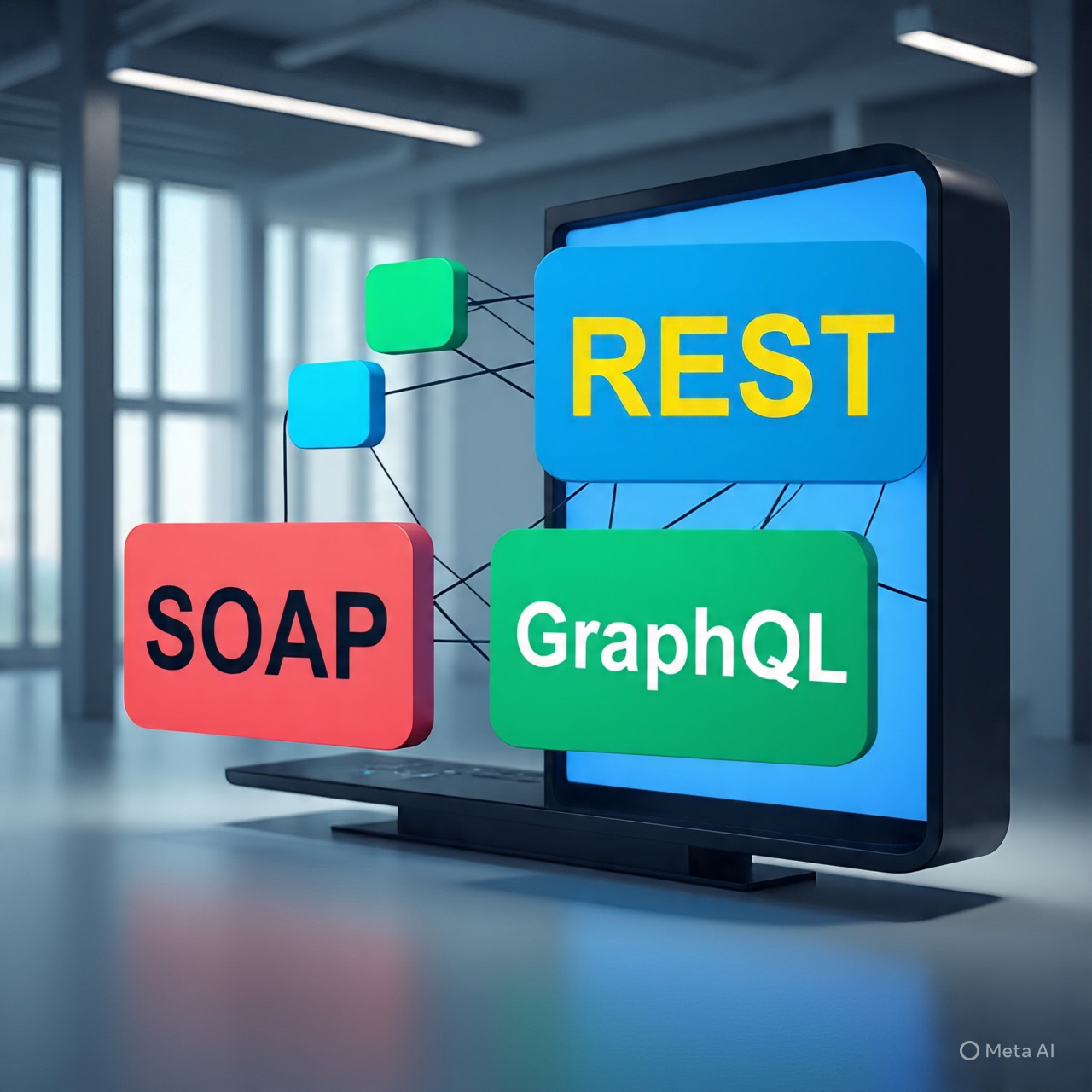
APIs are the backbone of modern software — powering everything from mobile apps to global enterprise systems. But with so many API styles available today, choosing the right one can be overwhelming.
This guide breaks down REST, GraphQL, SOAP, gRPC, and Webhooks, comparing their strengths, weaknesses, and ideal use cases in 2025.
🔗 What Are APIs?
APIs (Application Programming Interfaces) allow different software systems to communicate with each other. They define how data is requested, transferred, and structured — forming the “language” systems use to exchange information.
🌐 REST (Representational State Transfer)
REST is the most widely used API style on the web today. It relies on HTTP methods (GET, POST, PUT, DELETE) and typically uses JSON for data exchange.
Key Benefits
- Simple and scalable due to stateless architecture.
- Widespread support across frameworks, languages, and tools.
- Easy caching with built-in HTTP capabilities.
- Human-readable with predictable URL endpoints.
Potential Drawbacks
- Overfetching or underfetching — clients may receive too much or too little data.
- Multiple round trips for complex data structures.
- Loose specifications can lead to inconsistent implementations.
🧬 GraphQL
GraphQL is a query language developed by Meta that lets clients request exactly the data they need in a single request.
Key Benefits
- Efficient data fetching — no more over/underfetching.
- Single endpoint for all data operations.
- Strong typing with an explicit schema.
- Improved developer experience with introspection and tooling.
Potential Drawbacks
- Caching is harder compared to REST.
- Complexity increases for simple applications.
- Performance overhead for large or deeply nested queries.
📦 SOAP (Simple Object Access Protocol)
SOAP is a protocol-based API style designed for strict, secure, and highly standardized enterprise applications.
Key Benefits
- High security with WS-Security and strict standards.
- Strong contracts with WSDL formal definitions.
- Built for reliability in mission-critical environments.
Potential Drawbacks
- Verbose XML format makes it heavy.
- Steeper learning curve than REST or GraphQL.
- Less flexible for modern mobile and web applications.
⚡ gRPC
gRPC is a modern, high-performance API framework developed by Google. It uses HTTP/2 and Protocol Buffers (protobuf) for fast, compact communication.
Key Benefits
- Ultra-fast — ideal for microservices and internal APIs.
- Strong typing via protobuf schemas.
- Bidirectional streaming support.
- Low bandwidth usage.
Potential Drawbacks
- Not human-readable — protobuf requires code generation.
- Browser support limitations (requires a proxy).
- Overkill for simple web APIs.
🔔 Webhooks
Webhooks are user-defined HTTP callbacks used for event-driven communication.
Key Benefits
- Real-time updates without polling.
- Lightweight and simple to implement.
- Great for integrations (Stripe, GitHub, Slack, etc.).
Potential Drawbacks
- No delivery guarantees without retries.
- Harder to debug connection issues.
- Security concerns if endpoints are not validated.
⚖️ Side-by-Side Comparison
| Feature / Format | REST | GraphQL | SOAP | gRPC | Webhooks |
|---|---|---|---|---|---|
| Data Format | JSON / XML | Custom schema (JSON) | XML | Protobuf | JSON / Form Data |
| Speed | Medium | Medium | Slow | Very fast | Event-based |
| Schema Enforcement | Optional | Strong | Very strong | Strong | None |
| Use Case | Public APIs, web apps | Complex data & mobile | Enterprise & finance | Microservices, internal | Events & integrations |
| Ease of Use | Easy | Moderate | Hard | Moderate–Hard | Easy |
| Caching | Simple | Complex | Complex | N/A | N/A |
🚀 Which API Style Should You Choose in 2025?
It depends on your needs:
- Choose REST if you want simplicity, compatibility, and broad adoption.
- Choose GraphQL if your client needs flexible, efficient data requests.
- Choose SOAP for high-security, legacy, or compliance-heavy systems.
- Choose gRPC for fast internal communication between microservices.
- Choose Webhooks for event-driven integrations and real-time notifications.
“There's no one-size-fits-all API — the best option depends on your architecture and user needs.”
💡 Final Thoughts
APIs continue to evolve as applications become more interconnected and performance-driven. By understanding the strengths and limitations of REST, GraphQL, SOAP, gRPC, and Webhooks, you can design systems that are scalable, secure, and future-proof.
Whether you're building a modern SaaS platform, a microservices ecosystem, or enterprise workflows — choosing the right API architecture is one of the most important decisions you’ll make.