
Beyond Agentic AI: A Complete Guide to Modern AI Classifications
A clear and practical breakdown of the major AI classifications—beyond just agentic AI—including capabilities, learning paradigms, architectures, and functional roles.
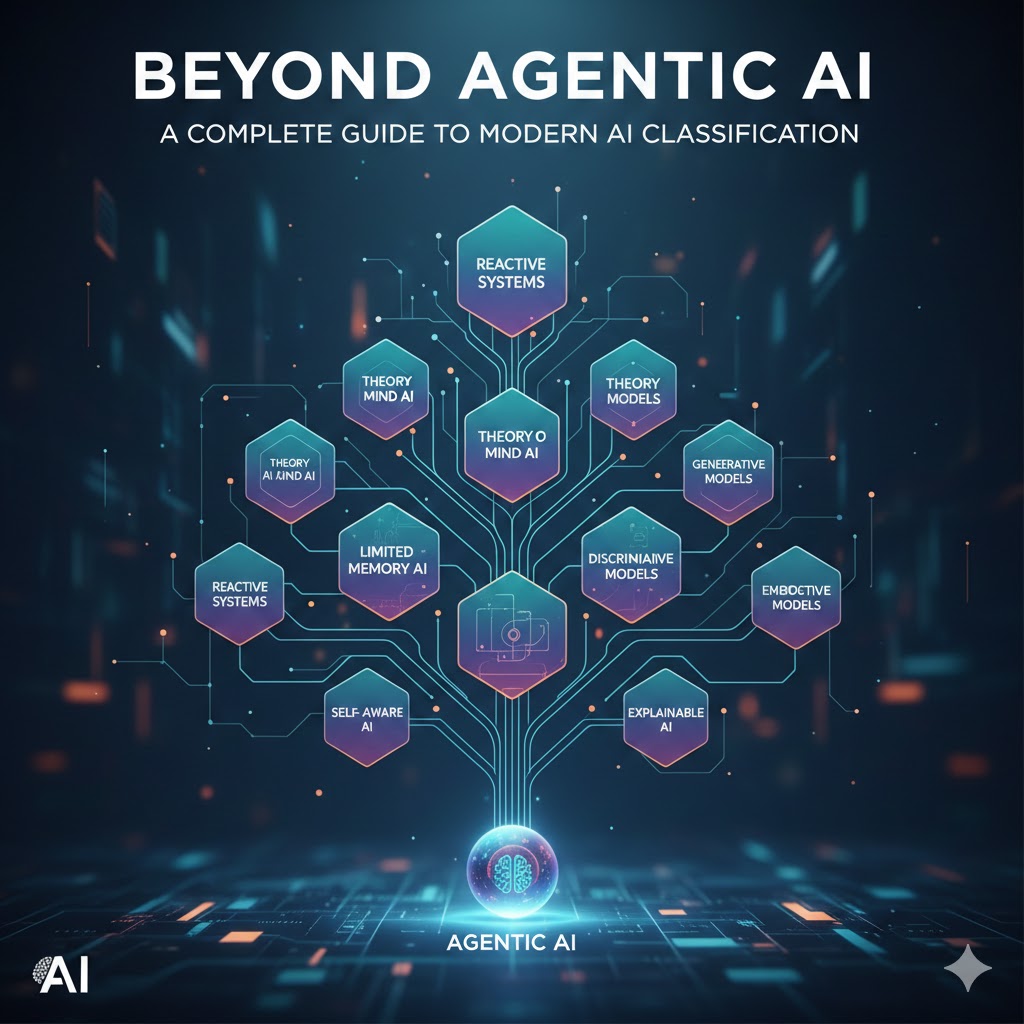
AI discussions in 2025 often revolve around agentic AI—systems that can plan, act, and pursue long-term goals.
But agentic AI is only one way to categorize artificial intelligence.
In reality, modern AI can be classified through many different lenses: capability, learning style, architecture, functionality, autonomy, and real-world usage.
This guide breaks down the most widely used frameworks for understanding AI today.
1. Classifications by Capability Level
Narrow AI (ANI)
AI designed for one purpose: image recognition, recommendation, speech-to-text, etc.
General AI (AGI)
Hypothetical or experimental systems capable of performing any intellectual task a human can.
Superintelligent AI (ASI)
AI that surpasses human intelligence across all domains—still theoretical.
2. Classifications by Learning Paradigm
Supervised Learning
Learns from labeled examples; used for classification and regression.
Unsupervised Learning
Discovers structure in unlabeled data; clustering, embeddings, anomaly detection.
Reinforcement Learning
Learns through rewards and penalties; often used in robotics and game-playing AIs.
Self-Supervised Learning
Major foundation of modern LLMs: models learn patterns directly from raw data.
Transfer & Few-Shot Learning
Systems apply acquired knowledge to new tasks with minimal extra data.
3. Classifications by Architecture / Model Type
Symbolic AI (Good Old-Fashioned AI)
Logic, rules, knowledge graphs, decision trees.
Machine Learning Models
Random forests, SVMs, KNN, gradient boosting machines.
Deep Learning Models
Transformers, CNNs, RNNs, diffusion models, graph neural networks.
Hybrid / Neuro-Symbolic AI
Blends reasoning with neural representation.
4. Classifications by Functional Role
Reactive Systems
No memory; respond only to current input.
Limited Memory AI
Most modern AI; uses short-term or long-term context.
Theory-of-Mind AI (Research Area)
Would recognize beliefs, emotions, and intentions.
Self-Aware AI (Speculative)
A theoretical future class of AI.
5. Classifications by Autonomy
Assisted AI
AI as a tool—autocomplete, IDE helpers, analytics assistants.
Augmented AI
Human + AI collaboration, such as copilots or design aids.
Autonomous Systems
Robots, drones, autonomous vehicles.
Agentic AI (for contrast)
AI that can plan, decide, and act independently toward goals.
6. Classifications by Domain or Application
- Perception AI (vision, audio, OCR)
- Language AI (LLMs, translation)
- Generative AI (text, images, music)
- Decision & Planning AI (operations, logistics, agents)
- Scientific AI (drug discovery, materials modeling)
Final Thoughts
The world tends to focus on whatever is new and exciting—right now, that is agentic AI.
But a broader understanding of AI classifications helps developers, researchers, and engineers speak more clearly about what systems can and cannot do.
Whether you're building apps, designing systems, or tracking AI trends, knowing these classifications gives you a precise map of the entire AI landscape—not just the trending slice of it.